A traveling band screen is a continuous loop of mesh or perforated panels that rotates through a channel, catches solids on its surface and lifts them out to be washed off by sprays. Band screens protect pumps, heat exchangers, desalination membranes and wastewater processes from leaves, seaweed, plastics, fish, jellyfish, hair and fibres.
which way the water passes through the band. That single choice decides whether debris can be carried over into the clean water, how much screening area you get per metre of channel, and how the screen fits into the civil works. This guide compares the three flow patterns, through-flow, dual-flow and centre-flow, side by side.
|
Through-flow |
Dual-flow (out-to-in) |
Centre-flow (in-to-out) |
|
|
|
Single-entry, direct-flow |
Double-entry |
Inside-out, centre-fed |
|
|
|||
|
|
|||
|
|
|||
|
|
|||
|
|
|||
|
|
|||
|
|
Power station and desalination intakes, retrofits of through-flow screens |
Wastewater fine screening, MBR pre-treatment, intakes with fish or high debris |
Through-flow band screens
In a through-flow screen the band sits across the channel like a wall. Water passes through the upstream (ascending) run of panels, then through the downstream (descending) run before it leaves.
The simplest civil layout: a straight channel with the screen across it.
A long track record at older intakes, so spare parts and installation experience are widely available.
The lowest equipment cost of the three.
The weakness: carryover. The spray wash at the head of the screen never removes 100% of the debris. Whatever stays on the panels travels over the head sprocket and down the descending run, where the flow can wash it off of the screen. Fibres, small fish, shells and weed fragments then reach the pumps or condensers the screen is supposed to protect. Each panel also has seal gaps at both runs, which doubles the number of places where debris can bypass.
Choose through-flow when debris is moderate, the downstream equipment tolerates occasional carryover, and the channel is short.
Dual-flow band screens
A dual-flow screen is turned 90℃ so the band runs along the channel. Water enters through both outer faces and leaves through the open centre of the band, out through an opening at one end.
No carryover. Water passes through the mesh only once, and debris always stays on the dirty side.
More screening area. Both runs of the band screen the water, so for the same channel width a dual-flow screen offers far more effective area than a through-flow screen. Lower through-mesh velocity follows, which means lower head loss and, at intakes, gentler conditions for fish.
A proven retrofit route. Dual-flow screens can be designed to fit the existing slots of a through-flow screen. Converting an old through-flow intake to dual-flow is a common way to eliminate carryover without rebuilding the intake structure.
The water leaves the screen at an angle, so flow conditions downstream of the outlet need checking, especially at pump suction bays.
The structural design of the band and the seal at the outlet end needs care, because the band carries the full differential load across a long span.
Choose dual-flow when you have a through-flow intake with carryover problems, a power station or desalination intake with high debris or fish protection rules, or a channel that limits width.
Centre-flow band screens
A centre-flow screen reverses the dual-flow path. Water enters the centre of the band through an open side and leaves outward through both runs. The solids are caught on the of the band and are lifted to the head, where sprays wash them into a central trough.
, and solids are fully enclosed, so they cannot fall back into the clean channel as the panels turn over the head sprocket.
Fine openings. The design suits perforated plate and mesh panels down to about 1 to 3 mm, which is why it is widely used for MBR pre-treatment and fine screening of municipal wastewater, where hair and fibres must be removed.
Fish-friendly options at intakes, because fish can be collected in buckets on the inside face and washed gently to a return trough.
Highest equipment complexity of the three, with more seals and a central collection trough.
In wastewater, the inside face needs effective brush and spray cleaning, and the spray water consumption should be part of the design.
Choose centre-flow when you need fine 3D screening (MBR, hair and fibre removal), when carryover is unacceptable, or when debris includes soft material that would smear on a bar rack.
If not (membranes, plate heat exchangers, condensers with small tubes), rule out through-flow.
Fine 3D openings of 1 to 3 mm point to a centre-flow screen with perforated plate. Intake mesh of 2 to 10 mm can work in any of the three.
For an existing through-flow slot, a dual-flow conversion is often the cheapest way to remove carryover.
In the United States, for example, the EPA's 316(b) rule for cooling water intakes lists a maximum through-screen velocity of 0.5 ft/s (about 0.15 m/s) as one compliance option for impingement. Dual-flow and centre-flow screens give more area, which makes low velocities easier to achieve. Fish buckets, low-pressure fish sprays and a separate fish return trough complete the design.
Jellyfish, seaweed and leaf fall can arrive in sudden, very large quantities. Size the speed range, spray system and debris trough for the worst event, not the average day.
Check access for panel replacement, spray nozzle cleaning and lifting of the whole screen, and provide stoplogs or gates to isolate each channel.
|
Woven wire mesh or perforated plate; openings typically 1 to 10 mm depending on duty |
|
|
AISI 304 or 316L stainless steel |
|
|
Duplex 2205 or super duplex stainless steel; copper-nickel mesh where biofouling is a concern; sacrificial anodes |
|
|
High-pressure debris sprays, with a separate low-pressure fish spray at intakes that return fish |
|
|
Differential level control, timer, high-speed mode, overload protection and SCADA signals |
ROCKERHILL designs and builds band screens, traveling water screens and cooling water intake screens for water treatment, desalination, power and wastewater plants. Every screen is sized from the client's flow, water levels and debris data, before shipment, and documented with a full vendor data sheet. Our references include a , supplied with stoplogs and radial gates for the same plant, so the screen and its isolation equipment come from one supplier.
Design, engineering and in-house manufacturing
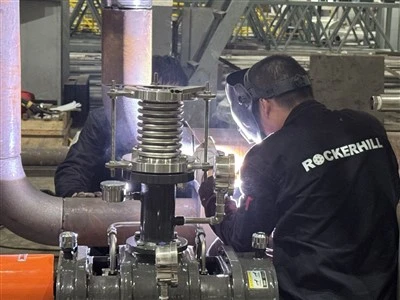
Band screens have more moving parts, seals and spray pipework than a bar screen, so fabrication quality and factory testing matter even more. ROCKERHILL designs and builds its band screens and traveling screens in house.
|
In-house design and engineering |
Our own engineers size the rack, chains, rakes, panels and frame by calculation from your flow, channel geometry, discharge height and water chemistry. We check the hydraulics before we propose a screen. |
|
|
4,800 mm7.3 m3 to 50 mm, a choice of bar profiles and mesh or perforated plate panels, AISI 304, 316L, duplex 2205 or coated carbon steel, and drives for the local power supply. |
|
|
General arrangement drawings, vendor data sheets, structural calculations, ITPs, O&M manuals and spare parts lists, in the client's format and revision system, issued for approval before fabrication. |
|
|
Design to ASTM, ASME, EN and GB codes or to the project specification; welding to ASME Section IX procedures; EN 10204 3.1 material certificates. |
|
In-house manufacturing |
Cutting, welding, machining, and pickling and passivation of stainless steel in our own workshops in China, under our own quality control, with visual and penetrant inspection of welds. |
|
|
Every screen is fully assembled and function-tested before shipment, witnessed by the client or recorded on photo and video. Third-party inspection is accepted. |
|
|
Export packing on flat racks or in bolted modules for wide units, installation drawings, remote commissioning support and site supervision on request. |
|
|
Screens, screenings handling equipment, and the penstocks, sluice gates, stoplogs and radial gates that isolate screen channels, from one engineering team. |
One team owns each project, from the first sizing calculation to the last commissioning check.
What is the difference between a through-flow and a dual-flow band screen? In a through-flow screen the water passes through the band twice, once on the way in and once on the way out, so debris can be carried over to the clean side. In a dual-flow screen water enters both faces and leaves through the centre, passing through the mesh only once, so carryover cannot occur.
Carryover is debris that is not removed by the spray wash and is released on the clean side of the screen as the band turns, allowing it to reach the pumps or heat exchangers downstream.
What is a centre-flow band screen used for? Centre-flow screens are mainly used for fine screening of municipal wastewater and MBR pre-treatment, and at intakes where carryover is unacceptable. Water enters the centre of the band and solids are caught on the inside.
Can a through-flow screen be converted to dual-flow? Yes. Dual-flow screens can be designed to fit existing through-flow screen slots, which removes carryover without rebuilding the intake structure. The intake hydraulics and supports must be checked as part of the conversion.
Typically 1 to 3 mm for MBR and wastewater fine screening, and about 2 to 10 mm for raw water, cooling water and seawater intakes, depending on what the downstream equipment requires.
Duplex 2205 or super duplex stainless steel for the structure and panels, with copper-nickel mesh where biofouling is a concern and sacrificial anodes for cathodic protection.
ROCKERHILL bar screens and related screening equipment are in service in the United States, Canada, Australia and Singapore, as well as Mexico, Croatia, the Middle East and China, among project references in 30 countries.
Yes. Our own engineers design every screen, it is fabricated in our own workshops in China, and it is fully assembled and tested in the factory before shipment.
Choosing a band screen for an intake or headworks? Send ROCKERHILL your flow, water levels and channel drawing, and we will recommend the flow pattern and mesh that suit it. Contact Allie at Allie.s@rockerhillcn.com.
], ROCKERHILL. Last updated: [Nov 17,2026].