Bar screen troubleshooting means tracing a screen's symptom, such as jamming, carryover or high head loss, back to its root cause in the hydraulics, the mechanics or the controls, and fixing that cause rather than the symptom. Most screen problems that operators fight every week have a small number of root causes, and many of them were built in at design or set up wrong at commissioning.
This guide is written for operators, maintenance teams and plant engineers. It covers multi-rake, climber and catenary bar screens and, where the cause is similar, band screens. It is based on what ROCKERHILL engineers check when we are asked to look at a screen that is not performing, including screens made by other manufacturers.
Safety first. Isolate and lock out the drive and control panel before working on or near any rake, chain or panel. Screens can start automatically on level or timer signals. Follow your plant's confined space and lock-out/tag-out procedures, and never clear a jam with the drive energised.
|
# |
|||
|
1 |
Gaps at side seals or bottom; bent or missing bars; rake teeth worn; through-flow band screen carryover |
||
|
2 |
|||
|
3 |
Large object (stone, timber, brick) wedged in the bars; grit build-up at the foot; bent bars |
||
|
4 |
Jams (see 3); chain tension wrong; worn guides; set point too low |
||
|
5 |
Check rake-to-bar engagement and wiper position |
||
|
6 |
|||
|
7 |
|||
|
8 |
|||
|
9 |
|||
|
10 |
|||
|
11 |
|||
|
12 |
1. Debris passing the screen
Carryover defeats the purpose of the screen and often shows up first as rags on pumps or in digesters.
Side and bottom seals. The gap between the rack and the channel wall or floor must be no larger than the bar spacing. Old concrete walls are rarely straight, so check the full height.
Bent or missing bars. A single bent bar can open a gap twice the design spacing.
Rake tooth wear. Worn teeth leave material on the rack that is later pushed through.
Through-flow band screens. Water passes the mesh twice, so debris left after spray wash can wash off on the clean side. A dual-flow or centre-flow conversion removes this risk.
Bypass channel. Check that the bypass gate is closed and that the bypass manual rack is not passing flow at normal levels.
2. High head loss
High head loss usually means the rack is more blinded than the design assumed.
Verify the level readings. Fouled ultrasonic or radar sensors and blocked bubbler tubes give false differentials. Compare readings with a staff gauge.
Review the control set points. A timer that is too long between cleaning cycles, or a differential start point set too high, lets the rack blind. Combine timer and differential level control, with a high-speed mode during storms.
Check rake speed. On multi-rake screens, more frequent cleaning keeps head loss low. If the screen has a variable speed drive, confirm it reaches high speed.
Recheck the hydraulics. If debris loads have grown since the plant was built (wipes are a common reason), the screen may simply be undersized. See our head loss calculation guide.
3 and 4. Rake jams and overload trips
The overload device (torque limiter, shear pin or electronic overload) is doing its job when it trips: it is telling you the rake hit something. Replacing the shear pin with a stronger one, or raising the torque setting, simply moves the failure to the chain, shaft or gearbox.
Grit and sand build-up at the foot of the rack, which the rake cannot pass
keep the channel floor clean in front of the rack, consider a grit trap or coarse rack upstream if heavy objects are common, and set the overload device to the manufacturer's value.
5 and 6. Screenings falling back or sticking to the rake
The rake teeth must engage between the bars over the full height of the rack, and the wiper or comb at the head must clean the rake completely at the discharge point. Check the wiper adjustment after any replacement of rakes or chains. Where fats, oils and grease are high, a small spray at the discharge point helps release screenings.
7 and 8. Chain, sprocket and bearing wear
|
Replace before metal-to-metal contact |
||
9. Grit settling in front of the screen
Grit settles when approach velocity falls below about 0.4 m/s. This often happens at night or in the early years of a plant built for future flow. Options include taking one of two channels out of service at low flow, adding a channel insert to reduce width, or flushing the channel regularly.
10. Overflow in storms
If the screen overflows or the bypass operates before peak design flow, check that the control system switches to high-speed raking, that both duty and standby screens run when needed, and that downstream equipment (a conveyor, compactor or skip) is not stopping the screen. If all of these are correct, the screen is likely undersized for today's flows and debris loads.
11. Odour and corrosion
Inlet works release hydrogen sulphide, which forms sulphuric acid on wet surfaces and attacks concrete and carbon steel. Fit covers with inspection doors, extract air to odour control, wash screenings and remove them frequently, and specify 316L or duplex stainless steel where H₂S levels are high.
12. Icing
In cold climates, exposed screens, chutes and compactors can freeze. Covers, heat tracing on chutes and discharge zones, and a control strategy that keeps the screen moving at intervals in freezing conditions all help.
|
|
|
|
|
|
|
|
|
|
Every 6 months |
|
|
|
Keep a stock of critical spares: shear pins, rake teeth or complete rakes, polymer guides and bushings, wiper blades, one set of chains and sprockets for large screens, and level sensors.
Upgrading is worth considering when the screen keeps tripping despite correct maintenance, when spare parts are no longer available, when debris loads have grown beyond the original design, or when the plant needs a finer opening. See our guide to retrofitting and replacing bar screens in existing channels.
ROCKERHILL designs and manufactures multi-rake bar screens, band screens and other screening equipment. Our screens use polymer guides and bushings on the chain and foot assembly, sealed bearings above the water line, and overload protection by torque limiter or shear pin plus an electronic trip. Every screen is supplied with an O&M manual, a maintenance schedule and a spare parts list [confirm before publishing: spare chains and rakes held in stock for ROCKERHILL screens]. We can also review the performance of existing screens from other suppliers and propose upgrades or replacements that fit the existing channel.
Design, engineering and in-house manufacturing
Many recurring screen problems start at the design and fabrication stage: poor bar alignment, weak seals or wear parts below the water line. ROCKERHILL controls these details by designing and building every screen itself.
|
In-house design and engineering |
Our own engineers size the rack, chains, rakes, panels and frame by calculation from your flow, channel geometry, discharge height and water chemistry. We check the hydraulics before we propose a screen. |
|
|
4,800 mm7.3 m3 to 50 mm, a choice of bar profiles and mesh or perforated plate panels, AISI 304, 316L, duplex 2205 or coated carbon steel, and drives for the local power supply. |
|
|
General arrangement drawings, vendor data sheets, structural calculations, ITPs, O&M manuals and spare parts lists, in the client's format and revision system, issued for approval before fabrication. |
|
|
Design to ASTM, ASME, EN and GB codes or to the project specification; welding to ASME Section IX procedures; EN 10204 3.1 material certificates. |
|
In-house manufacturing |
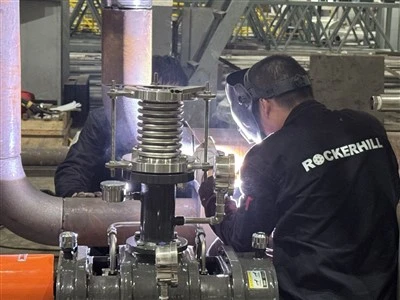
Cutting, welding, machining, and pickling and passivation of stainless steel in our own workshops in China, under our own quality control, with visual and penetrant inspection of welds. |
|
|
Every screen is fully assembled and function-tested before shipment, witnessed by the client or recorded on photo and video. Third-party inspection is accepted. |
|
|
Export packing on flat racks or in bolted modules for wide units, installation drawings, remote commissioning support and site supervision on request. |
|
|
Screens, screenings handling equipment, and the penstocks, sluice gates, stoplogs and radial gates that isolate screen channels, from one engineering team. |
One team owns each project, from the first sizing calculation to the last commissioning check.
Operators in many countries run ROCKERHILL screens, and we support them with documentation, spare parts and engineering advice. ROCKERHILL has project references in 30 countries.
Usually because the rake hits a heavy object, grit build-up at the foot of the rack or a bent bar. Find and remove the obstruction rather than increasing the overload setting.
The shear pin is protecting the drive from a jam or excessive load. Common causes are debris at the foot of the rack, wrong chain tension, worn guides or a pin of the wrong rating. Never fit a stronger pin than the manufacturer specifies.
Gaps at the side or bottom seals, bent or missing bars, worn rake teeth, or, on through-flow band screens, debris washed off on the clean side after the spray wash.
Daily inspection, weekly sensor cleaning, monthly lubrication and adjustment, six-monthly wear measurement and an annual inspection with the channel dewatered are a typical schedule. Follow the manufacturer's O&M manual.
A rack that is more blinded than designed, usually because the rakes do not run often enough, the level sensors are fouled or the debris load has increased.
When its measured elongation reaches the manufacturer's limit. Sprockets are often replaced at the same time if their teeth are worn.
ROCKERHILL can review existing screens and design replacement screens or upgrades to fit the existing channel. Send photos, drawings and the screen data plate.
ROCKERHILL bar screens and related screening equipment are in service in the United States, Canada, Australia and Singapore, as well as Mexico, Croatia, the Middle East and China, among project references in 30 countries.
Yes. Our own engineers design every screen, it is fabricated in our own workshops in China, and it is fully assembled and tested in the factory before shipment.
Fighting a screen that will not behave? Send ROCKERHILL photos, the channel drawing and a description of the problem, and our engineers will suggest the likely cause and a fix. Contact Allie at Allie.s@rockerhillcn.com.
], ROCKERHILL. Last updated: [Nov 17,2026].